Constellations Discussion
Today, we’ll explore:
What rejection sensitivity is and why it develops
Difference between being rejected and feeling rejected
How rejection sensitivity can affect friendships, dating, and community
Begin to discuss simple ways to slow down, question our assumptions, and build healthier relationships
This is a supportive, judgment-free space.
Please stay muted when not speaking.
Ask questions in the chat or with the “raised hand” tool anytime.

Presented by Kate Harrington
Founder of Harrington Matchmaking & Constellations program
Based in the Washington, D.C. metro area
Known for working with neurodivergent adults
Contact Information
kate@harringtonmatchmaking.com
harringtonmatchmaking.com
@katewhdc
What is Rejection Sensitivity?
Rejection sensitivity is the tendency to quickly notice, strongly feel, and intensely react to real or perceived rejection, criticism, exclusion, or disapproval.
Sometimes the rejection is real. Sometimes our brain is making a prediction, or anticipating being rejected.
It often looks like:
worrying someone is upset with you
overthinking texts, emails, or conversations
taking criticism very personally
feeling devastated by rejection
assuming the worst when information is missing
replaying social interactions in your head
We’re talking about a brain that has learned to watch carefully for signs of social danger.
Social danger is anything that threatens our sense of belonging, acceptance, connection, reputation, or place within a group.
Sensitivity Example
You send a text, make a call, or email and don’t get a response.
Someone else may think:
“They must be busy” and go about their day.
A person experiencing rejection sensitivity may think:
“They’re ignoring me. I had a feeling they were upset with me. I must have said something wrong …” and ruminate on it.
The emotional reaction can happen very quickly, often before we have all the facts.
Sometimes the rejection is real. But often, we’re reacting to the possibility of rejection rather than actual rejection.
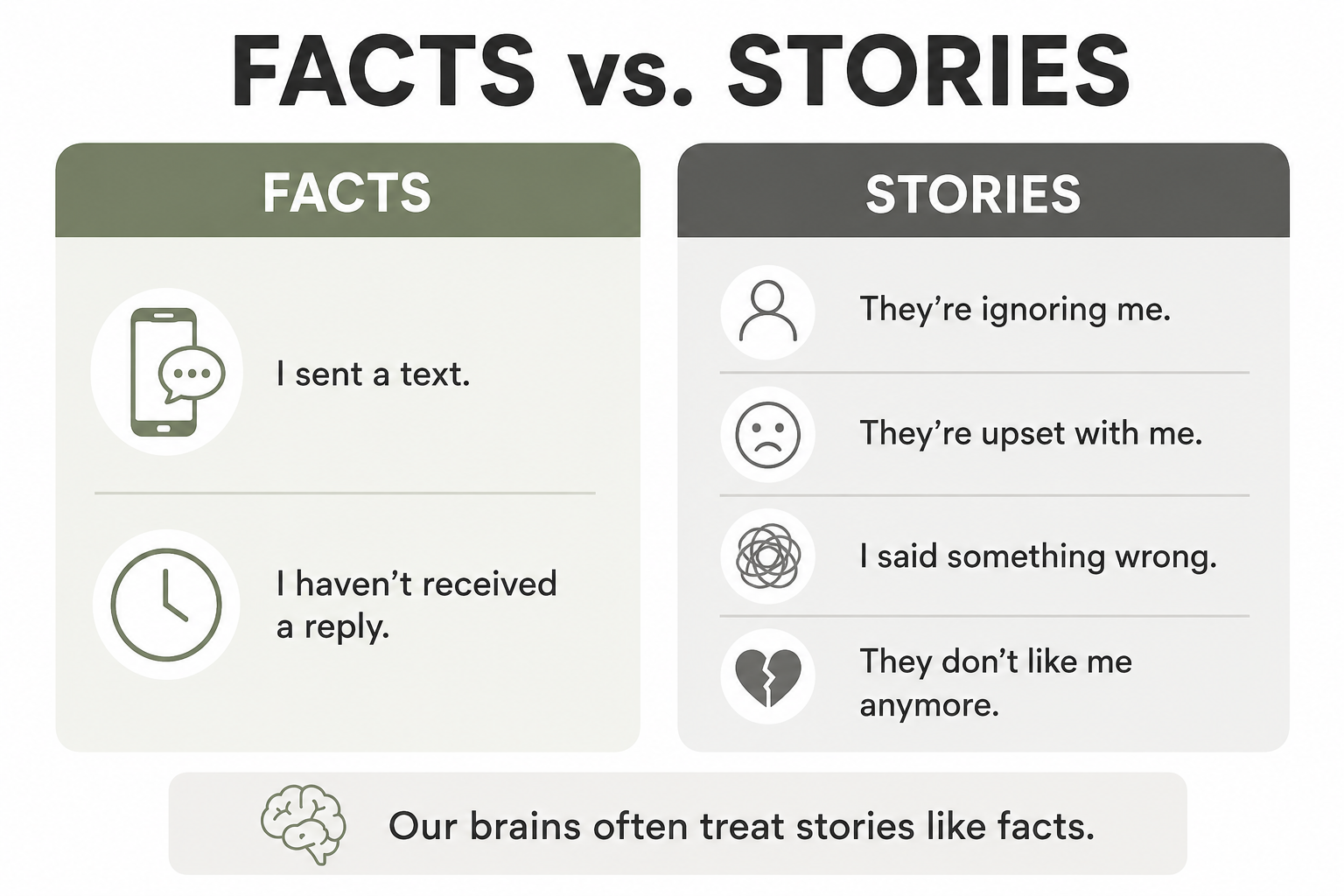
Our brains don't like uncertainty.
When we don't know why something happened, our minds automatically try to fill in the blanks.
For people with rejection sensitivity, those explanations often lean negative.
The brain isn't trying to make us miserable — it's trying to protect us.
If it can identify a threat quickly, it believes it can help us avoid being hurt again.
We’ll discuss this more in depth soon.

Discussion Break:
What are some situations that make your brain immediately wonder whether someone is upset with you, doesn’t like you, or is rejecting you?
What does it feel like in your body and mind when you sense rejection?

Where does this sensitivity come from?
Some of us do not know where our rejection sensitivity comes from.
For many people, it emerges after repeated experiences of criticism, exclusion, bullying, misunderstanding, or social failure. The brain learns from experience. When something painful happens often enough, it begins scanning for signs that it might happen again.
In this sense, rejection sensitivity is not a character flaw.
It is often an adaptation — a protective strategy developed by a brain that has learned that social interactions can be unpredictable or painful.
Examples:
A child who is laughed at every time they raise their hand in class may eventually stop participating — not because they have become shy, but because their brain has learned that speaking up can lead to embarrassment.
An employee who is repeatedly criticized by a supervisor may begin to feel anxious every time they receive an email notification, even when most emails are neutral.
Someone who has experienced rejection in dating may start assuming that a delayed text message means a loss of interest, even though there are many possible explanations.
In each of these cases, the brain is doing what it evolved to do: learning from past experiences and trying to prevent future pain.

Private Reflection:
Can you identify an early experience that may have taught you that rejection was something you needed to be on guard against?
Your Reflection
For some people, a single painful event comes to mind.
For others, there wasn't one defining moment.
Instead, it was a pattern of experiences that repeated over time.
This exercise is not intended to find someone or something to blame.
The goal is simply to understand how our brains learned to navigate the social world.
Many of the beliefs and protective strategies we carry today made sense at the time they were developed.
They helped us survive difficult situations.
The question we will explore throughout June is whether those same strategies are still serving us today.
Note on Neurodivergence
While anyone can develop rejection sensitivity, neurodivergent people often face experiences that make it especially likely.
Many grow up receiving more correction, criticism, and negative feedback than their peers. They may be told they are "too much," "too sensitive," "too intense," "too quiet," or that they need to change how they communicate or behave.
Many also experience bullying, exclusion, social confusion, or repeated misunderstandings.
Over time, the brain adapts. It becomes more vigilant, scanning for signs of disapproval, criticism, or rejection before they happen.
This adaptation makes sense — but it can also lead us to perceive rejection where none exists.
At its core, rejection sensitivity is often a nervous system trying to answer one question: "Am I safe, accepted, and wanted here?"



Discussion Break:
Growing up, what messages did you receive — directly or indirectly — about the way you communicated, expressed emotions, or interacted with others?
Do you find yourself scanning for signs of rejection, criticism, or disapproval? What does that look like for you?


When Rejection Sensitivity Takes the Wheel
Rejection Sensitivity doesn’t just affect how we feel.
It can affect how we behave in our relationships or workplace.
For this week, let’s look at one of the four common responses:
Withdrawing and avoiding social risks
Sometimes we stop taking social risks and withdraw.
Thoughts
“I don’t want to bother them.”
“They’re probably not interested.”
“They already have lot of friends.”
“They’ll never say yes to me.”
Behavior
Not reaching out.
Not attending events.
Not asking someone to hang out.
Not asking for a promotion.
Staying quiet even when you want connection.
Possible Consequence:
Fewer opportunities for friendship, dating, community, employment.
Thought → Behavior → Consequence
So, what do I do?
The first step is noticing the feeling.
Many people with rejection sensitivity move straight from feeling something to reacting.
The goal is to start interrupting that pattern by creating pause points between the feeling and reflexive reaction.
Signs “my rejection sensitivity may be activated …”
Racing thoughts
Urge to send another text or call again
Feeling embarrassed or ashamed
Feeling suddenly hopeless and overwhelmed
Assuming the worst immediately
You don’t have to argue with the feeling.
You don’t have to make it disappear.
Just notice it.
Name it.
“My brain is telling me a made up story right now.”
“My rejection sensitivity is kicking in again.”
That awareness alone can start to reduce the intensity.
Pause
Rule: Don’t make important decisions when your rejection sensitivity is activated.
This is where many of us get into trouble. We let our activated rejection sensitivity take the wheel and start influencing our behavior, leading to consequences.
Thought → Behavior → Consequence
Activated people controlled by their feelings …
send too many texts or call too many times
burn the bridge
end the friendship prematurely
delete the dating app
decide someone hates them
stop attending events
stop communicating desires or hopes
We need to learn to act from facts, not fear.

This week’s final thought:
Yes, our brains want to protect us. However, they become so focused on avoiding negative feelings that we begin also avoiding opportunity.
Over time, the goal shifts from building the life we want to avoiding the emotions we don't want.
The tragedy is that while avoidance can protect us from some rejection, it also prevents us from experiencing acceptance, connection, growth, and success. A life organized around avoiding rejection is often much smaller than a life organized around pursuing what matters.


Next Monday:
We’ll continue exploring common responses to RS, grounding techniques, the “facts vs story tool,” and how to move from self-criticism to self-compassion
Recommended Reading